Showing posts with label Suffolk. Show all posts

Saturday, 12 January 2013

The Sunday Muse!

Small "Panther" in the sun flecks!

Looking forward to spring!

 +Philip Spalding

This week has been the darkest of the year so far in the UK.  Dark  during the day because of the cloud.  Dark at night because of the cycle of the moon which ha made it apparently the best viewing conditions of the night sky.  We have had our astronomy "festival" on BBC TV Stargazing Live (may not open outside UK) with the comedian Dara O Briain (a comedian with a degree in Cosmology and Maths) and Professor Brian Cox current successor to the great Sir Patrick Moore.  As a nation we are captivated by these great televisual experiences.  We have even had Professor Brian Cox commentating on what to see in the Sun Newspaper (a British tabloid or red top) as I discovered while having a coffee in Deja Vu , local coffee shop that is run by local people.  Was almost tempted to get my telescope out (a Sky-watcher Reflector) but must be getting old as was a little too cold!

Looking forward to spring and the sun flecks starting to come through the leaves of the apple tree has started me thinking about vegetable gardening.  I have touched on this in previous years when blogging about micro-farms  or square foot gardening and green thumbs.  At the moment with snow predicted for tomorrow will probably have to make do with making vegetable soup.

The planning of the veg patch can start now.  The experiences I will relate in this blog as in previous years.  I have started an online learning community for Haverhill (Haverhill Online Learning Community or HOLC).  We have specifically marked in  a week for Urban Gardening on the Calendar of events starting the 11 th February 2013.  The Urban Gardening  page link will soon be available on the Projects Page.  There is a great increase in interest  in the UK in growing your own, with demand for allotments up in these times of austerity.  If everybody was to turn even one square metre of their back or front lawn  into a veg growing area we would not only reduce air-miles (and that's just the start) but also gain that satisfaction of producing our own food.  It does not even have to be a square metre even growing lettuce and salad leaves in plastic bottles tied like a terrace to a balcony wall can yield good results!

To finish off for this post then the new year's resolutions have been written.  One was to eat more Cretan/Greek food which I will do so once I have found my Cretan Cookbook.  Certainly I will be blogging more about the county that I love to be part of, Suffolk and it's great food and culture.  Will have to wait a bit for some more ducks to become available I think but you never know!      

Saturday, 29 December 2012

New Year for the 2 point five age of man

Resolution time

Time of the year when thoughts are turning to the new year of 2013.  We have survived the Mayan Calendar predictions.  Saw a good pic on Facebook "If the Mayans were so good at predicting the future, where are they now?" or words to that effect.  The continuing austerity imposed in 2012  is according to the UK politicians starting to work. So here's to a more affluent time for 2013.


Top five Key "moments" for the UK in my opinion in 2012

  1. Queens' Diamond Jubilee celebrations.  Not just for UK but for the whole of the Commonwealth
  2. London Olympics and Paralympics
  3. Signing of Better Broadband agreements across the UK
  4. UK not getting involved or "taking the lead" in Syrian Civil war by sending troops
  5. Continuing Bank misconduct exposure (not really one key event)

Top Five Tech moments for 2012 again  IMO
  1. Rise of Android as the leading mobile OS
  2. Google Plus Communities feature launched 
  3. Start of first Online Universities such as edX and Coursera
  4. Apple not winning all it's legal cases
  5. Rise of Phablets and Tablets over Desktop PCs
Obviously there are a myriad of other events that have shaped 2012.  The defining  moments may change through time as their impacts are felt. 

The major personal milestone for 2012 has been the setting  up of Haverhill Online Learning Community. This is going to occupy quite a bit of time through 2013.  Have look and if interested join or copy the idea for you own local community!

Will resume normal content of blog from now on based on good food, well being and stories about my home county Suffolk.

Saturday, 10 November 2012

The Saturday Foodie Bit! Newmarket Sausages!

National Sausage Week and the Newmarket Sausage!

The past week (from the 5th November to 11th November) it has been National Sausage Week.  On Tuesday I was in Newmarket, the place of my birth.  Tuesday is market day in Newmarket.  You still see old guys (getting fewer by the year) who wander in from the Fens and potter about the market.  The more eccentric still wear leather gaiters and look as though they have just come off the field or the fen.  They often look as though they have been collecting produce;  wild fowl, fresh caught eels or fresh dug vegetables.  

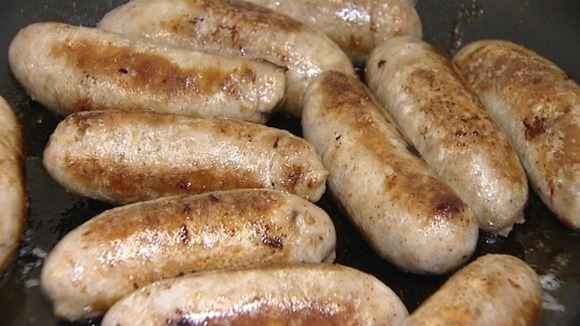
 Stroll just off the market down a side street and you start to come across two local butchers Musk's and Powters.  Recently the age old argument of who has the real Newmarket sausage recipe has been slightly resolved between the two.  The Newmarket Sausage has now been granted protected status. Three butchers applied for the status the two pictured left and Eric Tennants featured in the video attached to the BBC series.  The Wikipedia article on the Sausage gives some information but does need revising.  The area is not just Newmarket itself but Dullingham, Woodditton and Kirtling (over the border in Cambridgeshire).

Having wandered down the street to Musks they had an offer to try a sausage in a roll to celebrate their new status.  Who has the actual authentic recipe? It is probably lost in time, now probably largely irrelevant as you buy the one like. The sausage Queen Victoria enjoyed is probably subtly different since the Pork used today will not be the same owing to diet and progressive breeding of pigs.  If the regional foods of England are to survive PGI status is route. 


Saturday, 27 October 2012

Saturday Foodie Bit! At the change of the clocks.

Snow stops play! Well would
have done if wasn't November
last year!

Who is going to be early for the Sunday Lunchtime Pint?

A time of confusion in the next 24 hours will happen for some.  It is that time of year when we in the UK switch from Summer Time to Winter Time or to give it it's more official term Daylight Saving.  So if you haven't figured it out yet the clocks go back an hour.  So the pub opens an hour later (still same time but on winter time clock).

Have been spending Fridays recently, when there has been no work on, delivering my 70+ year old father (and mother) to Bury St. Edmunds for appointments.  Opposite the destination is the Greene King brewery.  Haven't really been inside yet but will do so at some point in the next few weeks.  The whole process of driving to Bury and waiting around for an hour and a half does not really give enough time to take the tour and sample the brews (driving and drinking being a non starter as well).  So the traditional Sunday Lunchtime chat and sampling of the brews in the Royal Exchange.

Had a wander around centre of Bury St Edmunds again.  There is a brew/wine making shop off the market square  that I have used before.  Angel Hill has a few butchers and obligatory pasty franchise shop.  A few pots and pans shops but not a lot of delis or shops selling local produce.  This is a great shame since Bury St Edmunds is at the heart of an area where great food is produced.  There is a market on Wednesday and Saturday, but yesterday was Friday!

So with the prospect of snow in the UK (hence the picture) I am going top share a not so Suffolk recipe but one from Sicily!  Still try to think winter is not here! I used Google Translate to share a starter last week from the Montalbano cook book.  My Italian is not great but we have enough latin based words in the English language to have a stab at the meaning.  Looking through the recipe book using Kindle Desktop I have selected a first course.

FIRST COURSE 

Pirciati ch'abhruscianu

Ingredients: (for 4 people)
400 gr. of pirciati (typical Sicilian pasta) or penne
80 gr. grated pecorino cheese
1 onion
4 cloves of garlic
4 anchovy fillets in salt
1 hot pepper
10 gr. of chiapparina (capers purposes)
40 gr. black olives
1 sprig of basil
olive oil
salt and pepper

In a frying pan with oil, fry the onion and garlic finely chopped. Add the anchovies, chilli, chopped, capers and olives. Cook the pasta in salted water, drain and toss with the sauce. Add the cheese to each dish, a few basil leaves and a sprinkling of black pepper to taste.

Campo, Stephanie (2010-04-08). The secrets of the board of Montalbano. Recipes by Andrea Camilleri (Italian Edition) (Kindle Locations 725-726). The green lion Editions. Kindle Edition.


The recipe could also be a light lunch.  What I like about this the fact you can all of this in a British supermarket with out too much trouble (even Anchovies most of the time!).  Also it does not have the supposedly essential Italian ingredient,  pomodoro or tomato!

May share a Suffolk recipe if this weather keeps up! 


Saturday, 29 September 2012

Sunday Foodie Bit! Viticulture UK!

A vineyard on Jersey: still part of the British experience

Wine a British Drink!

A Sunday in the UK.  Clear sky, just approaching dawn, at 6 am still dark, moon is starting to set.  A  male Owl on old Railway Track at bottom of the Garden, no reply to his part of the twit-ter-whoo. Probably a Barn Owl. Cat has some competition for the local rodent population at last, maybe won't have so many presents placed next to and in food bowl!  

Recently I have been blogging about the Great British Apple.  An event of note is taking take place today (30/09/12) at Audley End House, an Apple festival.  This based around the Organic Kitchen Garden at the house and features experiences from the 1880s.  Apples in this scenario would have been important for large estates attached to the house for producing cider.  Cider was used as part of the wages for the estate workers during harvest time.  Greenhouses attached to the Kitchen Gardens would have been employed to produce grapes for the table, and in some houses pineapples.  Wine would not be made from grapes since the fashion was for grapes to be presented to honoured guests.  Viticulture was not an active part of the estate management over time even though wars with France often restricted the supplies of wine.  Alternative sources often were imported from England's oldest ally the Portuguese.  Port and Madeira have long featured in English cooking and may be making a comeback, especially white port, as more people visit Portugal.

Prior to the loss of Aquitaine,  England had control of large areas what is now the premier Red Wine growing region of France.   The red Bordeaux wines we import into England as Claret come from this is area.  England has a rich history of wine making if you go back to the time when half of the western half of France was under English control (do not tell the French this as they conveniently forget this sometimes!).   In fat today a lot of the trade is till controlled by English interests.  

Flag waving over, what is the English wine (this is a specific definition as there is also British wine made from imported grapes) growing experience? The standard argument most oenologists use  to justify growing wine in England is that Romans did so in Chester and if they could do it then we can do it now.  Climate change apart from then and now, it is possible to make decent grape based wine in England.  Hedgerow wine is a different product but can be equally good!    

As I like to blog about Suffolk I am going to concentrate on identifying the vineyards in the local area to me.  Haverhill is a market town on the Suffolk, Essex and Cambridgeshire border.  We have very near to us (about 5 miles) one of the major labels in English wine Chilford Hall.  I have visited this conference/wedding/function hall and vineyard many times.  The wine is prize winning and does taste good, a white wine grown on the Chalk slopes of the start of the Gog Magog hills close to the highest point in Cambridgeshire.  The source of the River Stour is not that far from the vineyard and consequently the soil is well drained.

Very close to Chilford on the other side of the Gog Magogs on the approach to Cambridge is the Gog Magogs Vineyard .  This is a recently established vineyard (in 1995).  I personally haven't yet tried any of the wine but since it has the same basic terroir (can we use that in England, sounds better than soil) as Chilford Hall similar good results could be expected.

A vineyard that I visited about 7 years ago when the original owners were running it is Giffords Hall in Suffolk. My house at school was named after this hall, the other two being after Kentwell Hall, and Melford Hall so has a little connection to me.  A small vineyard operated by just one couple, the tour was pretty eccentric and entertaining as  the process was explained.  Impressed by the passion and knowledge I borrowed the video of the process and used it in Science Lessons to illustrate the fact that science is a very old profession not just a preserve of 19th and 20th Century white coated individuals.  The wine was good too.  Another visit is due I think!

A vineyard  near Wixoe a few miles down the road no longer exists.  Here they may have have been following in the footsteps of the Romans.  Wixoe and the surrounding area are rich in remains of Roman settlement   It is  near here that Boudicca may have defeated the IXth Legion after she sacked Colchester.

Still in Suffolk but a little further away towards Bury St Edmunds (home of Greene King) are the two vineyards Ickworth House and Wyken Hall .  These are two vineyards that I have yet to visit or taste their products but are in my list of things to do in Suffolk.

So these are the Suffolk and Cambridgeshire vineyards within about 20 minutes drive of Haverhill.  Few places have so many vineyards so close!

Saturday, 22 September 2012

Sunday Foodie Bit! In a Pickle!

Fruiting and then decay, new life next year!

Season of Harvest!

Fast approaching is the time when fresh British produce will start to disappear off the shelf in the supermarkets!  We are already seeing some of this happening.  Food we are warned will be slightly (understatement) more expensive and certain supermarkets seem to be upping the price already even though there is still British produce about.

We have higher wheat prices on the way owing to poor harvests.  A knock on effect is that feedstuffs will increase for livestock and the price will go up!

So turn back to the traditions of Northern and Eastern Europe and start pickling all that is available now!   May be time consuming but can be rewarding in the fact you have achieved something yourself.  A social element of pickling can also be achieved.  I have many years ago run a pickling competition in the local pub.  I bought a bag of onions (14 lb in old value) and then sold the onions for at a £1 a pint to participants with the money going to charity.

 As Christmas approached the  participants all started comparing their onions verbally.  Seemingly they knew their onions.  All sorts of nefarious advice had been given as to how best to make your onions, varying from chillies to some rich soul suggesting adding malt whiskey.  Participants were     starting to become nervous, stories of people tasting one of their jars and then deciding that they needed to add "improvers" started to provoke grumbles of  un-sportmanslike behaviour.  

The judging night came along on the Sunday usually just after Christmas or there abouts.  The evening had also matured into a cheese  evening!  The range of cheeses brought in as favourites ranged from Stinking Bishop to Shropshire and a very unimaginative Dairylea, but at least they brought their onions!   Washed down with whatever Greene King drink happened to be at hand, the "tasting scores" for each onion were totalled up and then the winner was declared.  The only memorable verdict of the night was that malt whisky is not a good additive for pickled onions! 
   
Pickling recipes to follow!

Wednesday, 19 September 2012

Suffolk Landscapes!

Ancient Suffolk Landscapes

A superhighway of the mediaeval age.  A packhorse bridge!  This brook might appear to be a small obstacle to travel.  Today the water level is low due to the extraction of water for surrounding houses and farms.  This is on the ancient route between Bury St Edmunds and Cambridge.  The speed of transport is undoubtedly slower (only just sometimes) than the A14.  This is part of a walk that takes in the Icknield Way that can be found in the guide 50 walks in Suffolk (ISBN 0749535652).  As you walk this walk you see the  remnants of the mediaeval industrial structures. 

Malt kilns are evidence of the rural economy gearing up for batch production of a commodity that was seasonal.  Arguably this type of flue structure is one the most common technogical innovations seen in everything that involves heating or cooling.  We even look to the termite mounds of the animal kingdom use of this structure as solution to cooling large buildings.  

There are many great walks around West Suffolk! Over the next few weeks I will blog about some of my favourites within the West Suffolk, North Essex and South East Cambs border area.   

Thursday, 13 September 2012

Suffolk Foodie Bit! The Friday Market!

Wintry view across Haverhill from the "new" market
Tescos (Super?) to the church where old market, stalls
can be found in it's shadow to the right!

Markets Ancient and Modern in Haverhill

Haverhill is a very ancient Settlement!  The new Haverhill Research Park  emphasises the similarity between the modern land use and the past land use of the area.  In developing the area a history stretching back to at least Roman times and prehistoric times has started to be uncovered by the Archaeological dig taking place as part oft he development.  Hints of the use of new technologies in the field of agriculture are being found in this site that echoes the biotechnology focus of the Research Park!

Along the spring line of the southern ridge of the Stour Brook the town of Haverhill developed.  The steeper northern  ridge has arguably a lot thinner soils and even today is known as the Chalkstone Hill.  Looking across to the church from the bottom of the Chalkstone Hill the more gentle rise supplies the bulk of the old town.  Haverhill market reputedly has a charter that goes back to the 1200s.  The positioning of it close to the crossing point of the Stour at Wixoe made it a convenient halt on the route from Sudbury to Cambridge. This local Livestock market originally behind the Bull, Queens Head and Rose and Crown continued  until the late 1960s and early 1970s.

So today I am going have a wander around the market square and have a look at the opportunities to buy fresh produce fresh produce on what was the Peas Market Site!  So a second blog post on this subject soon to appear!


Wednesday, 12 September 2012

Suffolk Foodie Bit! Suffolk Hams!

Self designed Logo that goes with my
other activities!  See the Blog
http://tinyurl.com/8slcvlw

Suffolk Ham Masters.....?

Recently I started following a Facebook page called "Spanish Ham Master".  This is a specialist, trained in the art of carving Iberian Hams.  I was thinking, what have Spanish Hams got that we have to have a trained specialist in just one aspect of Pork serving? 

Looking a little further I noticed the name bellota.  Curious as to the meaning of bellota I did a Google which led me to the Wikipedia article on Jamon Iberico.  Bellota would appear to relate to Black Iberian pigs (or at least 75% cross bred) fed on acorns, bellota.  The process of free range production of the pig takes 48 months on  a strictly controlled diet of ultimately acorns or olives.  The use of the Oak forests (Cork Oak?) on the Spanish/Portuguese border produces the highest grade of this protected Spanish Denomination de origen  product.  A further curing of the ham for 36 months in a dry environement produces a 7 year production lifecycle of the product.  Having had a look at the website associated with the premium product Bellota Ham it retails at £340 per 8.5 kg (£40 per kilo) bone in ham.  Or putting it in time span mode £5.70 per kilo per year from the supplier.  A good figure to keep in mind when comparing different production styles and deciding whether a product is value for money!

So Suffolk Hams, how do they compare as specialist product? Well for a start the end product is a pickled smoked ham that is then cooked.  The process probably  reflects the differences in climate between Suffolk and the Iberian Oak forests.  The process is not geared to a hard and fast Denominacion de Origen regulation, since technically it is a cure so could be produced anywhere.  Ultimately the  pickling process may contain beer, stout or cider.  Recipes for Suffolk Black Hams also include molasses in the mix.  The time for production of the ham takes approximately 10 weeks.  The Rick Stein Food Heroes Supplier Emmetts of Peasenhall     has been offering Hams for sale since 1840.  Doing the production time span figure for the retailer again works out at approximately £27 per kilo assuming using pigs killed that year.  

Why is Suffolk Hams not as visible as Iberico Hams in the Supermarkets?  The Suffolk Ham is an artisan product.  Admittedly more expensive to the consumer, and not as labour intensive.  A real case for celebrating a premium product?  Definitely so!  Denominacien de Origen status, why not? 

I may have made a good case for why Spanish Acorn Ham appears to be good value for money.  However, it needs to be remembered that they are different products and have different seasonal time for eating.  Wouldn't it be great to have a Suffolk "tapas" of air cured Hams, pickled onions, line caught herring roll mops washed down with Suffolk Cider, Dutch Gin or hedgerow liquors!


Saturday, 8 September 2012

Saturday Suffolk Foodie Bit ........ Duxford and Almonds!

Part of Battle of Britain flight displaying at Duxford
as seen on Queens Diamond Jubilee

Air Spectacular's annual appearance!


In my part of Suffolk the appearance of vintage aircraft in the sky over Haverhill used to signal the beginning of the annual Duxford air display at Imperial War Museum aerodrome. As Stansted Airport  has expanded the flight corridors have become more restricted.   The free displays I used to see as a child in our back garden from the Red Arrows, as they lined themselves up with old Colne Valley Railway remanant of which still exists,   are sadly not possible.  We still see the odd vintage Spitfire and Hurricane flying below the air corridor but only on rare occasions.

Haverhill being just on the edge of the East Anglian "high" plateau had a number of airbases around it.  Some were RAF and  some later American.  Fighters from the RAF were based at Castle Camps.  Light bombers and Heavy Bombers at Wratting Common, USAAF at Ridgewell.  This was all in the space of 4 to 5 miles from the town.   Apparently the dance halls (there were two on the High Street) could be interesting places on Saturday night when other personnel including the Army were billeted in town!

Surrounded by all the bases, Haverhill had a relatively "quiet war" considering the potential targets.  In March 1941 a Dornier bomber did make an appearance.

A passage taken from the book "Haverhill's Home Front" Compiled by The Haverhill and District Local History Group and Roy Brazier.

Some Haverhill residents still remember this attack, including a lady who had just stepped
out of her bath, and looked out of the window to see the aircraft sweeping low over the rooftops towards her, and she saw plainly the pilot looking down. I wonder if he recalls seeing the lady, and did he report back when reaching his home base that the English people were very short on clothing? The lady straight away ran, downstairs to tell what she had seen, before realising she was still without clothes. "...It was when I was with Mrs. Marsh at Duddery Road that a German 'plane came over very low and started to machine gun houses in our area and down to Meetings Walk, hitting our attic and a brick wall that divides Duddery and Mount Roads. An incendiary bullet struck a wooden post leaving scorch marks ... "

Meetings Walk is of interest to me as until recently I had lived there for 12 years.  An 1896 Victorian terrace built from local bricks, whose clay was dug apparently by the Haverhill Brick Company at the top of the terrace!
Meetings Walk with Old Independent Church, at the
top of the spire is a Cockerel! 

At the back of the houses an access road allows occupants to park car in their garages and on property.  This is an innovation that had not been thought of at that time the houses were built.  At the top of the road


Travel and transport, however, at this time was not a problem.  Haverhill boasted two railway stations.  One serving the line going North to Cambridge and thence all points "globally".  The other servicing the South line along the Colne and Stour valleys.


Meeting Walk in Winter
Haverhill was an important town for clothes manufacture.  During the Second World War Haverhill company Gurteen  was involved in the manufacture of uniforms.  So there is a good chance that the uniforms featured in Parades End currently on TV (IMb entry)   were made in Haverhill.   In fact the Church featured in the photograph was built by the Gurteen family as were a lot the houses (except Meeting Walk) in the area.  Gurteen is a company still going and involved in the town, occupying the Chauntry Mills (at present the home for the Centre for Computing History) that has a working steam engine!


During the wartime the diet of the local workers was restricted to rationing.  Allotments did feature as a  necessary supplement to many peoples diet (something that may make a comeback).  Again a piece from the   "Haverhill's Home Front"


"... we were issued with Ration Books but as my four boys were only little they did not eat much so we had a bit extra for the grown-ups. Our allotment gave us plenty to eat. One favourite meal I made was with onions and potatoes put in layers and served up with brown sauce, that was a 'no meat' meal. Meat was kept in a little meat safe, usually made of wood with a wire mesh front. No fridge or freezer about then ... "


Imported nuts such as Almonds were restricted in their availability and use.  Almond essence, a emulsion of bitter almond extract and alcohol)  started to be part of the dessert menu.  There were even mock almond pastes  that ingenuity and Ministry of Food nutritionists concocted.  Before the import of chocolate Almonds were an important sweet meat in Europe.  Probably the Second World War where chocolate became a luxury rationed item probably drove the Almond out of the larder since there was a greater sugar hit!  American influences post 1942 may have had also an impact!

 A local recipe for Almonds Ipswich Almond  Pudding would have been one of the casualties of the ration book.  Maybe time to revise the use of the Almond in this country!

Ingredients (to serve 4)


1/2  pint (250 ml) milk
5 fluid oz (150 ml) double cream
2 oz (50 g) fresh white breadcrumbs, finely grated
3 oz (75 g) sugar
6 oz (150 g) ground almonds
1 teaspoon (25 ml) orange flower water or rose water
3 eggs, beaten
1 oz (25 g) butter

Step 1:  Heat oven to 350°F or 190C.

Step 2:  Warm the milk and cream together in a saucepan. Put the breadcrumbs into a bowl, then add the milk/cream mixture and leave to stand for approx 5 minutes.

Step 3: Add the sugar, ground almonds and orange water or rose water and leave to stand for a further 10 minutes until all the liquid has been absorbed.

Step 4:  Stir in the eggs, blending well. Pour the mixture into a buttered 2 pint (1 litre) pie dish. Dot the
surface with the butter. Set the pie dish in a roasting tin. Pour boiling water into the tin until it comes about a quarter of the way up the side of the pie dish.

Step 5: Bake for 30 minutes.

Serve accompanied by single cream.


I will continue to collect a range of Suffolk Recipes and use of food and vegetables!  Next up should be a blogpost on local ciders, ancient and modern!


Wednesday, 5 September 2012

Suffolk Foodie: Apples ..... more Apples!

Windfall Bramleys

Autumn's dropouts

Thump!  Another one hits the patio!  It's the sound of Autumn arriving.  Having recently moved back to stay with parents I have been looking at the family tree.  The family apple tree.

The apple tree has long been a feature of our family gardens.  As a child the first thing that happened when we arrived at my Grandfather's North London house was to climb the apple tree.  Whichever cousin (there were eventually twelve of us) arrived for the gathering first, the trick as we reached a certain age was to be the first up the tree!

Harvest time as my grandfather became older involved being sent out with a bag to gather the windfalls.  Large quantities of apples were then transported back (picked or naturally harvested either by wind or own weight) to Suffolk.  As the convenience and availability of apples in shops took over the apples increasingly fermented to themselves and were eventually dumped! 

Little Panther at tree base as I Telework
in the Garden trying sufficiently
early in season to avoid windfalls
A sappling was planted nearly 35 years ago in the parent's lawn in Suffolk.  It was supposed to be a half standard!  Over the years it has spread it's boughs unchecked producing a variety of sizes of apple. It has become a cat exercise frame, a bird feeder support, washing line post, a swing platform for nephew and nieces as well as a slalom hazard for the lawn mower. As it becomes older it is succumbing to various diseases to a greater or lesser extent!

We haven't yet had a transfer of misteltoe as often happens with birds placing seeds from a last meal in a convenient crevice.  This parasitic plant  can reduce the vigour and health of an apple tree.  The season of christmas with mistletoe becoming an economic crop could be one reason to poke about in old orchards.  Old Orchards are becoming sought after as repositories of forgotten varieties that store well and have good taste.

The resurgence of interest in cider is a good example where "artisan" producers are looking to find the mix of good apple that produce juice, enough sugar for natural fermentation but are not necessarily the best for storage.  The variety Sturmer Pippin, very popular in Australia and New Zealand,  was recently rediscovered in the village of Sturmer not 3 miles from where I am writing this blog!  Suffolk has a great tradition of producing good apples and good cider (Aspalls being an example but more on that another day).

Recipe then for windfall apples called Windfall Apple Pudding!
Ingredients

PASTRY
6 oz  (150 g) flour
3 oz (75 g)  cooking fats (Lard etc)
Pinch of salt
Cold water to mix
FILLING
2 large eating apples
1 egg
2 oz (50g) caster sugar
1 large cooking apple
1 oz (25g) self raising flour
2 oz (50 g) seedless raisins,
Icing sugar for dredging


Step 1:Set over to 375°F or 190 C .
Pastry
Step 2 :  Put the fats, salt and flour into a bowl, cut the fat into small pieces and rub in lightly.
Step 3: Add about 1 and 1/2  tablespoons water and mix with a fork.
Step 4: Knead lightly and roll out on a floured surface and line an 8 inch pie
plate. Overlap the rim by 1/2 inch (approx 1.5 cm) and turn back the pastry overlap to form a double
rim.

Filling and putting it together.
Step 1: Peel, core and slice the apples, mix with the raisins and pile in the
pastry case.
Step 2: Beat the egg and sugar together in a bowl until thick and creamy, fold
in the flour and pour over the filling.
Step 3: Bake for 35 minutes or until golden brown.

Dredge with icing sugar and serve with custard or pouring cream.

Tomorrow?  More Apple stories that may involve Chips but only of the type prepared from fruit from the tree!


Tuesday, 4 September 2012

Suffolk Foodie Bit! All organic?

When is organic ..... organic?

Traditional Suffolk Clay Pot for traditional food.  When we think of traditional food we think of the pre-green revolution era of organic food.  A big question has been raised by a US study of the health and wealth of organic food.

So the question is what is organic?  Is it healthy or a good marketing handle?  An open set of questions that will need an objective set of answers.  

The Green Revolution is the post 1940 spread of technology that increased yield at far higher rate than previously.  As with most industrial shifts it had been slowly happening before somebody put a name to it 1968 (first recorded use).  However, this is a modern  view of the world of agriculture where fossil fuel intensive  high inputs of chemicals coupled to accelerated breeding with efficient harvesting technology produce high yields.  This coupled with modern transport networks results in the movement of vast amounts of carbon, water, phosphates and nitrogen about the planet.  In order to replace the nitrogen first world fertiliser production is then exported back to areas where traditionally either "natural" fertilisers such as locally produced manure was used or more exotically guano ( and superphosphates by  Fisons as well as pesticides).  In the Stour Valley a similar trade in food and manure operated more locally with London (http://2pointfiveageofman.blogspot.co.uk/2010/12/suffolk-food-and-festive-fare.html). 

We had pre-1940 produced food in quantities that did vary seasonally (something we talk about in this country).  We had methods of preserving, freezing, pickling, drying, salting etc. .  Did we have the 30 to 40% of food that is thrown away in households then?  Did we have the food rejected because it did not conform to a supermarket specification (curly cucumbers for instance)?  Are we using rose tinted spectacles on a a very complex problem and believing what we are told rather than exercising our common sense?  A misshapen carrot  can equally be as good as a straight carrot, it might not produce great battens but is still useful in a soup or stew!

So a recipe using misshapen carrots for country cooking.

A Farmhouse Vegetable Soup that can serve 4 people. Basic, everyday vegetables make up this chunky, everyday standby soup.

Ingredients

1 lb (454g) carrots, prepared and coarsely chopped
1 lb (454g) onions, peeled and coarsely chopped
2 sticks of celery, prepared and chopped
1 leek, prepared and sliced
2 oz (50 g) butter
2 lb (900 g)  potatoes, peeled and coarsely chopped
1 pint (approx 500 ml) lamb stock
Bouquet garni
Salt and pepper

Method 

Step 1: Melt the butter in a large saucepan
Step 2:  Add the chopped vegetables  ( reserve the potatoes for adding at later step)
and cook for 10 minutes, covered, stirring occasionally, until the vegetables are soft.
Step 3: Put the potatoes, stock, bouquet garni and salt and pepper into the pan and add
enough water to cover the vegetables. Bring to the boil and simmer for 45 minutes.
Step 4: Remove the bouquet garni and serve. The potatoes thicken the soup and may
disappear into the liquid.
        
Serve with bread of your choice.

In more straightened times this may have been a meal with a cheese known as "Suffolk Bang".  Suffolk Bang was a cheese of close texture and very hard.  The cheese was produced by continuous skimming of the milk in order to leave no cream.  A poem by Robert Bloomfield  "A farmers boy" written in the year1800, describes not only this cheese but also the relationship between the area of the Stour Valley and London (reproduced in Clive Paine' collection A Suffolk Bedside Book  ISBN1-904349-06-04).

And finally a little observation on the efficacy Fisons products.

A lorry and a tractor collided opposite Bugg's Stores in Loddon High Street. As a result the tractor crashed into the shop window, completely wrecking at least half the frontage. The tractor was owned by Fisons, the pest control experts.

As soon as the shop front had been boarded up, the following notice was chalked up in bold letters:

THEY TRIED!
BUT FISONS PEST CONTROL
COULDN'T KILL BUGG'S
BUSINESS AS USUAL

(Reproduced  from the Book  of East Anglian  Humour ISBN 0-948134-59-3) 


Tuesday, 28 August 2012

Suffolk Foodie Bit!


A Suffolk Blonde!

Tastes of Suffolk!

September is knocking on the door.  Suffolk is definitely a rural county today!  The products found on our shelves many and varied, the wheat beer shown left is a good example.  This time of harvest is a good reason to look at some of the food and drink related activities in the county and surrounding area!


The season of the food fayre is starting!  There was a food event in Bury St. Edmunds over the last weekend.  Various shots have appeared via the local accountancy firms Facebook page.  In Cambridge on Parkers' Piece (famous as the home of  association football)  there is the annual Cambridgeshire food festival in two weeks.  


A few topics to discuss over the next few weeks: Hedgerow wines, pickling onions and Suffolk traditional recipes!


Saturday, 18 August 2012

The Sunday Garden Shed!


When is an allotment not an allotment?

The debate of what constitutes an allotment hit the news this week.  An allotment holder was taken to task for growing fruit trees on his patch (Telegraph 16th August).  The allotment holder was told that three-quarters of the allotment should be put to "productive crops".  A very loose term generally but not in this case apparently.

The picture to the left is an allotment society's plot that I was involved in a few years ago.  The trust that owned the allotments was apparently divided over whether to sell the land for housing.  This is a very rural village in West Suffolk. Arguably West Suffolk is one of the least developed areas for housing in the East of England because it is still essentially an Industrial Landscape.  An agricultural industrial landscape and has been so for hundreds of years.  It could be argued that without the Agriculture of Suffolk the sprawling metropolis of London would not have been able to grow.   

The value we put on allotments is very much in the eye of the beholder.  Allotments were originally provided for low paid workers to give access to the means of supplementing your own diet by growing your own.  Today we have food banks that can be used to supplement diets set up on the back of overbuying and production by the supermarkets.  A laudable green solution to disposing of mountains of food that the supermarkets would otherwise bin.  This, however, reflects a little of the aid culture we have developed.  Instead of giving food to developing nations (from whom we buy our supermarket produce all year round) We are now doing it at home with finished and packaged goods.  Give a man a fish and he will eat for a day, give a man a fishing rod and he could also eat tomorrow.

In an ideal world it would be argued that everybody grow at least part of their own food.  However, in the time poor and on demand requirement for cheap food this is a rose tinted view.  Or is it? We tend to look at the cost of small parts of the food supply chain.  In supermarkets we buy either on price or perceived quality indicated by the marketing packaging.  The food contains the same major nutrients but may have those nutrients processed more or less depending on perceived added quality.  Everyday value brand or premium brand (often the same product) is a "choice" for the consumer.  Looking closer at the produce we have the major food chemical components of carbon, nitrogen and phosphorous (and not forgetting water since  lettuce's water content is 94.5% making a 500g lettuce roughly half a litre of water) being transported at great expense around the world.  Kenya as an example may produce beans of different types all year round but is exporting a major source of nitrogen to northern Europe.  To produce grain it would then have to import nitrogen generated from expensive and potentially insecure oil supplies.  This is without considering the cost of composting waste nitrogen in Europe and the effects of eutrophication. How long before Kenyan economists start to do the maths and decide like Russia did last year that domestic consumption is more important and cost effective than the balancing act of  food export income and food production costs?   

In Haverhill we have the pressure of our green areas and allotments being developed http://www.haverhillecho.co.uk/news/latest-news/education-centre-proposals-are-slammed-1-3798542.  This is reflected in moves a foot nationally to build on green belt land, again!  A food security question needs to be addressed with a concern that globalisation may have made western consumerism vulnerable.  The  vulnerability being  of home consumption in the country of production as  populations becomes more affluent! 

Friday, 17 August 2012

The Saturday Foodie Bit!


Sqaure Foot Gardening

The Square Foot Garden!

First Earlies Arran Pilot not 2 minutes
 out of the ground
Sunshine across the veg patch today!  I started on this veg patch on or about the last day in March. I probably started a little late this year. The intention was to experiment with the patch to see if I could produce some veg for a family of four!  Weather permitting there was the potential to produce some veg. However, drought then too much rain and more importantly cold overcast days and cool nights conspired to make a poor showing!  However we did have some results with  potatoes grown in bags!


Square foot gardening is a concept readily achieved in any garden.    A good guide to square foot gardening can be found at http://www.gardenorganic.org.uk/schools_organic_network/leaflets/SquareFootGardening.pdf .   This is a leaflet I have been using for many years.  I was very surprised to see the number of square foot gardening sites that turned up in the Google Search.  This is obviously a trending movement since a year ago when I last looked there were relatively few sites!  A blog article I wrote awhile ago explains a little of the theory behind this form of micro-farming http://2pointfiveageofman.blogspot.co.uk/search?q=square+foot.

With Summer almost drawing to a close the all round veg patch can be kept going!  Now is the time to sow turnips, winter lettuce, japanese onions, winter radish, swiss chard ( very popular ingredient in a lot of Mediterranean countries), perpetual spinach, cabbage and kale.  These are all hardy and will survive most of what the British weather can throw at us.  If you are not going to want to produce produce through the winter, sowing a green manure crop is a useful alternative.  Not only can they add nutrients and structure to soils but also act as a weed suppressant as they out compete by vigorous growth and cover!  For adding nitrogen to soils deep growing Alfalfa (good for improving structure of soils) and crimson clover (sowing season March to August so just within the window).  Alfalfa can be left for a year or more before before digging in.  Crimson clover can be dug in just before flowering, this prevents self seeding and it becoming a weed (a plant growing in a place where it is not wanted).

New "sowing" has been a bit of theme this week.     I have been experimenting with starting off a sourdough culture.  This is a bit of ancient microbiology relying on natural airborne yeasts.  So potentially each batch of sourdough is unique in it's microflora owing to geographical position and time of year.  This is a bit like local honey that contains local pollen that some people recommend as a supply of antigen for controlling hay fever reactions.  Potentially also a good way of acclimatising the bodies immune system to local yeast strains.  Using River Cottages Bread Handbook as the reference I set up a culture.  A flour and water (1 cup flour, 1 cup water) batter was made in an earthenware jar and set aside to ferment.

The Batter
Fermentation and checking, started
fermentation within 36 hours  

Preparing for the first feeding of the culture
with 1 cup of flour and and one of water


Have found that the recent warm temperatures during the day and much cooler temperatures during the night do influence the rate of fermentation.  The aroma from the culture has also changed during the process to a now pleasant sweetish alcohol laden "nose" (makes it sound like a fine wine).

Next step is to discard halve and add more flour and water.  In the next next few days hopefully I will making bread!

Monday, 6 August 2012

Ten year Plan - How it is going!


With Hindsight!

Word Count 833 

A friends wedding nearly six years ago  prompted me to start considering where I was heading.  It may have been the beginning of the "mid-life" crisis or a realisation that we were heading for major changes in my career path at the time.  At the time I did not realise quite how much of the crowd I was!


An interesting career that had experienced a lot change up to that point http://www.linkedin.com/in/philipspalding66, was about to become more interesting.  I sat down in the pre-wedding gathering in Weymouth (it had only just been announced as an Olympic venue) and contemplated the 10 year plan.  I made a statement that I would not be teaching full time in the classroom by the age of 50 (Eddie Izzard's new 40!).  I had an early night on the final night went back to the B & B.  Early next morning I boarded the ferry from Weymouth to Jersey.

In Jersey I stayed at my usual hotel in St Helier, the Mountview, and contemplated my statement.  I had a few pints in the more traditional pubs in the West End of St Helier.  A very good one with sporting prints from "antique" times was the venue to watch the Test Match and listen to the sage at the bar who also turned out to be the chairman of the Jersey Cricket Federation.  Picked the right pub!  But then you only have to look at the outside of the pub sometimes and know it is not going to be just q quick half to test the beer and atmosphere.

A few days of visiting my distant cousins in the north of the island (http://www.durrell.org/).  The orangutans seemed well, the funky gibbons were being funky.  They share an enclosure to simulate the Sumatran and Borneo rain forest habitat.  By the end of the break as I flew back into Stansted I had a bit of a plan.  Not quite a cunning plan but one that had light at the end of the tunnel which did not seem to be generated by a Eurostar! 

Another year on from this the following August and certain career paths appeared to be getting narrower (now we see the result good or bad?  http://www.eadt.co.uk/news/suffolk_cabinet_member_under_fire_after_suffolk_slumps_in_league_tables_1_1472060 ).  I was sitting in the bar in Pefki, Rhodes with a good friend shooting the wind as we  prepared for the Wedding.  A Rhodian escape started to be planned.  The mad engineer friend of mine combined with the agri-IT-scientist-teacher came up with a cunning plan.   A sustainable living/ well being plan, but in essence still a plan.

Two days alter back at work and the plan was shelved for another year until I went to Crete.  Fabulous island, cradle of European civilisation (forget mainland Greece)!  Schools Organisational Review (SOR) was just stating to come in and Haverhill along with Lowestoft was in the firing line.  A little bit of relaxation in Hersonissos led to realisation that work-life balance was really not balanced favourably on the cliff edge.  A couple of good nights spent in the company of a very attractive and relaxed Irish girl from Dublin and we started planning again!

The plan was expressed graphically in the Logo above. Sometimes you do not always need to write things down since the written word can always be misinterpreted by "experts".  Visit to a local print shop, and day later had the plan on a disc, five polo shirt (I went there and got the Polo Shirt, T-shirts were not good enough quality).  Scratch Rhodes, Crete would appear to be part of the plan! 

So back to work and another year of battling career change I finally hit the buffers.  An article in the Harvard business review started me thinking.  A position I had occupied through major career traumas such Ofsted, special measures, six (not really sure if some were actually allowed to be) head teachers and school federation was that of a Middle Manager.  The Harvard Review produced some insights (http://2pointfiveageofman.blogspot.co.uk/2010/12/death-of-middle-manager.html).      I had started to blog by this time.  The following March, I made a clean break and walked away from the pressure of achieving continual goals against the trickle down management culture of similar to First World War Generals.  Whistle goes and then over top! (Blackadder Goes Fourth clip here  http://www.youtube.com/watch?v=IglUmgYGxLM).  

Two years on from the break with the treadmill and the BlackAdder goes Fourth clip seems apt in the context of the East Anglia Daily Times article  http://www.eadt.co.uk/news/suffolk_cabinet_member_under_fire_after_suffolk_slumps_in_league_tables_1_1472060.  

Still have weathered all this, the ten year plan is half way through!.  I have achieved the stated aim of not needing to be in the classroom full time or managing change (for change sake?).   Last time I jumped out of a plane I definitely had a parachute, this time I have to construct it on the way down!  Necessity does become the midwife of creativity and invention!  Here is to more blogging and on ward and upward up with up hill skiing!

Καλημέρα σας και είναι εδώ για τα επόμενα πέντε χρόνια! Ή θα έπρεπε να είναι ένα νέο σχέδιο δέκα χρόνια!

Wednesday, 30 March 2011

Web 2.0 for business and Educators

Started Wednesday 30th March 2011
Words 423
S.I.= 85%
Digital Revolution hiccups and Digital leaps
Have not really had as much time as I thought this last week.  I have stepped back into the Worlds of teaching at a School in Ely and been progressing my own business and a project for AN Other.

Last week saw the fifth Birthday of Twitter.  Yesterday saw a major glitch in the BBC Website which apparently was due to a faulty, mechanical, optical or software controlled it certainly revealed the problems for business continuity.  More on this later.

 Another special event happening is that Freeview Digital TV is starting for some people today on the Suffolk/Essex Border if their transmitter is turned towards Sandy Heath.  If your analogue signal (ordinary BBC 1, 2, ITV 1, Channel 4 and Five)  works now try scanning with Freeview box or Freeview TV.  Best position for aerial 12 m above ground apparently with no obstruction (does work with roof aerials if close to transmitter)

Friday sees the upgrade  of the Business functionality on Facebook.  This will give same types of activities you can do with a personal profile.  Business pages are still within your Facebook registration, you are not supposed top have more than one account.  In fact you can be deFacebooked if you are in this state of duplicity.  Recently there have been groups removed from Facebook for extreme political views reported in the press so they are monitoring.

The Business continuity issue highlighted by both recent natural disasters and the outage of the BBC Website. The e-commerce end was affected as well as the News feeds.  The BBC was no longer the most up to date news source at that time.  The possibility exists that further outages may happen since the components, if it was a switch, may all have been put in at the same time.  Buy a brand new house and you will usually most of the light bulbs fail at roughly the same time.  The local Business Continuity Network to West Suffolk and South Cambridgeshire has gone live with its' website Business Continuity Network .  Time to integrate my own survey of my practices if the worst comes to the worst and I loose my main desktop.

I attended a meeting last week in Ipswich where the focus was sustainable workplaces.  I am developing my areas of Business interest to enhance the skills to go with this and also the Web 2.0 and cloud implications that go with this.  I will be blogging on my WordPress sites about this over the next few days. 

Wednesday, 16 March 2011

Wellbeing on a Thursday

Getting closer to escaping to that break on Crete
Started Thursday 17th arch 2011
Words 399
S.I.= 79.8%


These are a few of my favourite things


A time to pause briefly.  I have been driving around West Suffolk in ever decreasing circles.  A lot of ground has been covered in what has been quite a complicated piece of organisation and logistics.  Most of the task complete.  Very interesting to see how many businesses there tucked away in barns or down  little country lanes.  Telework  (Telework Association http://www.tca.org.uk/) ideal way to reap benefits of working in a rural environment while having a global presence.  Communications are not great East to West in Suffolk.  However West Suffolk is almost grazed by the M11 and Stansted (plea to airlines could we have a service to Crete from Stansted restored since Aegean Airlines became Greece's national carrier have to trek all the way to Gatwick or Luton) is on the door step.

Looking forward to taking advantage of some the opportunities that the Olympics 2012 events can offer tickets have gone on sale.  There are also opportunities for small businesses to be able to bid for part of the supply chain services.  Most large projects have apparently been managed by multinationals (had a conversation with a big Aussie friend who is subcontracting in Stratford) and most of the actual work is being done by firms in East London.  Suffolk on the doorstep, West Suffolk even more so as only 1 hour away, has a great opportunity.

Todays' blog is ostensibly about wellbeing.  I have found the last few weeks that as I have cranked up the wheels of personal industry that even micro blogging can be useful if you are a small business person to not only sometime record your experiences but also share your expertise.  Shouting in a desert can be almost the same as trying to clap using only one hand.  Tweeting at the moment is turning up a vast array of new contacts and opinions.  As people start to get used to tweeting you start to see the personalities of people emerge.  they are generally positive and forward thinking.  This is infectious on a damp foggy morning in Suffolk. Unlike Facebook 140 characters makes you think of the message you are trying to convey.  Blogging definitely falls into the category of a Reflective Journal that can be used to manage and assess your own Wellbeing.  To quote one of my fellow tweeters on Wellbeing, happy  tweeters keep followers. 

Sunday, 6 March 2011

Monday Morning Week 6 of Chinese New Year

Loch Ness  monster spotted on Holiday in Crete
Started Monday 7th March 0530 GMT
Words 531
S.I.= 106.2 % Aspirational Target not met
Week before the Ides of March


looking at the calendar planning what is going to be a very busy week I stated to think of the associations with the times of year.  The Ides of March falls next week on the 15th March.  I have not had a look at Pepys diary for a while, I wonder if anything has changed (ie similar situations different names).

What do I need to achieve by the end of the week?  The first priority is to make sure that I have considered a Wellbeing strategy.  I have found some of the course notes and literature from 2006 when I was a Wellbeing facilitator in my previous job in a school.  As a staff governor ( I really need to update my Linked in profile to reflect my experiences adequately) I took on this role at quite a difficult time for the school.  Special measures  looming again (we just avoided it again), eventually a change of head, acting head was in place, School Re-organisation taking place from 2007 (moves to close Middle Schools in Suffolk, happened in Haverhill and Lowestoft but unsurprisingly not happening anywhere else in Suffolk).

Against this background the one thing that senior management should have been putting in place was a wellbeing strategy but this did not happen.  Now I am running my own business with a view to employing others in the future it is time to make sure that I build my business to be a stress resistant organisation since I can set the agenda and learn from these experiences.

The first question should always be what do we want to achieve?  The second question is what are the benefits to us?  The this what are the costs, both financial and from an emotional intelligence perspective?  The most important out of the four process is the do next bit setting  out aims with a clear time frame and success criteria evaluation.  A detached non-emotional evaluation of the aims then needs to a priority no matter whether there is success or failure.  To quote one of my Twitter communicants    (I will not put her link here as you can search for me and then locate janeaninspires if you so feel inclined) "Tomorrow, instead of looking at what you don't have, examine all that you do have and be grateful! I'm just saying..... :)". Even better  is her comment, "Even if you win the rat race, at the end of the day, you are still a rat! :)" although I still like to win but maybe do it with the original spirit of Baron de Coubatin.

PS also start Advanced Electricians course to be able to install and certify Solar Panels.  A distance learning course I will be using the Wednesday Blog (have achieved career change so do not really need to revisit preparation phase) to be able to keep a reflective diary of the e-learning practice.

PPS Forget almost what was happening with Samuel Pepys? A little bit of blowing his own trumpet (but that is what most diarists do to a certain extent)?  And he was contemplating a career change.  Even then Lawyers and barristers were earning obscene amounts!