Showing posts with label Food. Show all posts

Saturday, 10 November 2012

The Saturday Foodie Bit! Newmarket Sausages!

National Sausage Week and the Newmarket Sausage!

The past week (from the 5th November to 11th November) it has been National Sausage Week.  On Tuesday I was in Newmarket, the place of my birth.  Tuesday is market day in Newmarket.  You still see old guys (getting fewer by the year) who wander in from the Fens and potter about the market.  The more eccentric still wear leather gaiters and look as though they have just come off the field or the fen.  They often look as though they have been collecting produce;  wild fowl, fresh caught eels or fresh dug vegetables.  

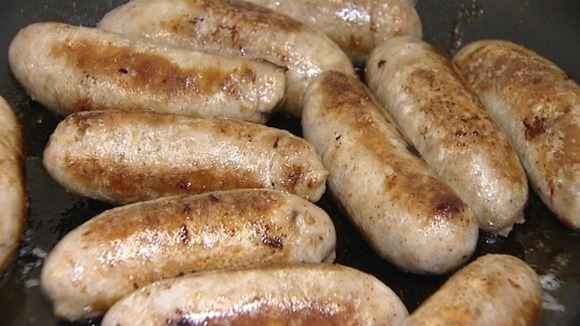
 Stroll just off the market down a side street and you start to come across two local butchers Musk's and Powters.  Recently the age old argument of who has the real Newmarket sausage recipe has been slightly resolved between the two.  The Newmarket Sausage has now been granted protected status. Three butchers applied for the status the two pictured left and Eric Tennants featured in the video attached to the BBC series.  The Wikipedia article on the Sausage gives some information but does need revising.  The area is not just Newmarket itself but Dullingham, Woodditton and Kirtling (over the border in Cambridgeshire).

Having wandered down the street to Musks they had an offer to try a sausage in a roll to celebrate their new status.  Who has the actual authentic recipe? It is probably lost in time, now probably largely irrelevant as you buy the one like. The sausage Queen Victoria enjoyed is probably subtly different since the Pork used today will not be the same owing to diet and progressive breeding of pigs.  If the regional foods of England are to survive PGI status is route. 


Saturday, 27 October 2012

Saturday Foodie Bit! At the change of the clocks.

Snow stops play! Well would
have done if wasn't November
last year!

Who is going to be early for the Sunday Lunchtime Pint?

A time of confusion in the next 24 hours will happen for some.  It is that time of year when we in the UK switch from Summer Time to Winter Time or to give it it's more official term Daylight Saving.  So if you haven't figured it out yet the clocks go back an hour.  So the pub opens an hour later (still same time but on winter time clock).

Have been spending Fridays recently, when there has been no work on, delivering my 70+ year old father (and mother) to Bury St. Edmunds for appointments.  Opposite the destination is the Greene King brewery.  Haven't really been inside yet but will do so at some point in the next few weeks.  The whole process of driving to Bury and waiting around for an hour and a half does not really give enough time to take the tour and sample the brews (driving and drinking being a non starter as well).  So the traditional Sunday Lunchtime chat and sampling of the brews in the Royal Exchange.

Had a wander around centre of Bury St Edmunds again.  There is a brew/wine making shop off the market square  that I have used before.  Angel Hill has a few butchers and obligatory pasty franchise shop.  A few pots and pans shops but not a lot of delis or shops selling local produce.  This is a great shame since Bury St Edmunds is at the heart of an area where great food is produced.  There is a market on Wednesday and Saturday, but yesterday was Friday!

So with the prospect of snow in the UK (hence the picture) I am going top share a not so Suffolk recipe but one from Sicily!  Still try to think winter is not here! I used Google Translate to share a starter last week from the Montalbano cook book.  My Italian is not great but we have enough latin based words in the English language to have a stab at the meaning.  Looking through the recipe book using Kindle Desktop I have selected a first course.

FIRST COURSE 

Pirciati ch'abhruscianu

Ingredients: (for 4 people)
400 gr. of pirciati (typical Sicilian pasta) or penne
80 gr. grated pecorino cheese
1 onion
4 cloves of garlic
4 anchovy fillets in salt
1 hot pepper
10 gr. of chiapparina (capers purposes)
40 gr. black olives
1 sprig of basil
olive oil
salt and pepper

In a frying pan with oil, fry the onion and garlic finely chopped. Add the anchovies, chilli, chopped, capers and olives. Cook the pasta in salted water, drain and toss with the sauce. Add the cheese to each dish, a few basil leaves and a sprinkling of black pepper to taste.

Campo, Stephanie (2010-04-08). The secrets of the board of Montalbano. Recipes by Andrea Camilleri (Italian Edition) (Kindle Locations 725-726). The green lion Editions. Kindle Edition.


The recipe could also be a light lunch.  What I like about this the fact you can all of this in a British supermarket with out too much trouble (even Anchovies most of the time!).  Also it does not have the supposedly essential Italian ingredient,  pomodoro or tomato!

May share a Suffolk recipe if this weather keeps up! 


Saturday, 6 October 2012

Sunday Foodie bit! Sicilian cookery!

The Montalbano Cook book!


I have become a fan of the BBC 4 foreign detective show time slot on Saturday night!  We have had the Nordic detectives of Wallender and the Danish/Swedish female detective with the famous jumpers (name slips my mind).  Now we Commisario Montalbano (have included a non-BBC link as often difficult to access BBC iplayer sites from outside UK), probably the best of the lot so far!

Against a background of traditional Italian stereotypes of  Sicilian characters the island is show cased as a spectacular backdrop.  Probably not on the must visit tourist trail, this is the largest Mediterranean island.  Being such a large island it has a great diversity of climates and soils.  In such an area there is a great diversity of food.  Mixtures of Greek, Arabic, mainland Europe and Italian cooking have washed over the island with the different owners.

Montalbano features many different dishes using this produce.  The main character spends a fair amount of time on food orientated meetings/lunches something that is not seen in many detective dramas.  A cookbook or list of recipes would be great to follow.  The humble aubergine seems to take on a life outside being stuffed, frittered or moussaka-ised. 

So task for the week to find one of the recipes featured in the latest episode and have a try!

Saturday, 22 September 2012

Sunday Foodie Bit! In a Pickle!

Fruiting and then decay, new life next year!

Season of Harvest!

Fast approaching is the time when fresh British produce will start to disappear off the shelf in the supermarkets!  We are already seeing some of this happening.  Food we are warned will be slightly (understatement) more expensive and certain supermarkets seem to be upping the price already even though there is still British produce about.

We have higher wheat prices on the way owing to poor harvests.  A knock on effect is that feedstuffs will increase for livestock and the price will go up!

So turn back to the traditions of Northern and Eastern Europe and start pickling all that is available now!   May be time consuming but can be rewarding in the fact you have achieved something yourself.  A social element of pickling can also be achieved.  I have many years ago run a pickling competition in the local pub.  I bought a bag of onions (14 lb in old value) and then sold the onions for at a £1 a pint to participants with the money going to charity.

 As Christmas approached the  participants all started comparing their onions verbally.  Seemingly they knew their onions.  All sorts of nefarious advice had been given as to how best to make your onions, varying from chillies to some rich soul suggesting adding malt whiskey.  Participants were     starting to become nervous, stories of people tasting one of their jars and then deciding that they needed to add "improvers" started to provoke grumbles of  un-sportmanslike behaviour.  

The judging night came along on the Sunday usually just after Christmas or there abouts.  The evening had also matured into a cheese  evening!  The range of cheeses brought in as favourites ranged from Stinking Bishop to Shropshire and a very unimaginative Dairylea, but at least they brought their onions!   Washed down with whatever Greene King drink happened to be at hand, the "tasting scores" for each onion were totalled up and then the winner was declared.  The only memorable verdict of the night was that malt whisky is not a good additive for pickled onions! 
   
Pickling recipes to follow!

Wednesday, 19 September 2012

Sour dough!

Natural Sourdough!

Ancient Science!

In 1961 the Chorleywood process of making bread changed British ideas of what was a good loaf.  Fifty one years on and 80 % of all bread in the UK is made the Chorleywood way.  

Bread is not a cheap commodity any more with rising costs of wheat and fuel.   So what is the alternative to a Chorleywood process loaf.

A myriad of flat breads have been produced all over the world using different grains.  Soda Breads although considered to be a traditional Irish bread may only really date back to the 1840s.  Apparently bicarbonate of soda was only produced commercially from 1846.  Sour dough bread is a form that seems to be becoming popular again. This is the pre-Chorleywood style of bread using a yeast culture that is fermented and kept going from one batch to the next.

Each sour dough culture is unique to the area in which it is fermented.  The local microbes are adapted to the climatic and environmental conditions.  By introducing airborne  yeasts and bacteria to a flour and water paste a classic colonisation phase is et up.  As the different microbes set up a symbiotic relationship between lactobacilli and yeast.  Move your culture to a different environment and the culture changes owing to different growing conditions.  Truly a local food product!

As we have moved away from random inoculation of bread with yeasts and bacteria we have gone for uniformity of yeast strains.  We are only just noticing the possibilities of  the self-sustaining cultures that restrict growth of other types of bacteria.  Very common bacteria such E. coli that have even found in bean sprouts are rarely (not aware of case) transferred in bread.  Remarkable considering that it is regularly handled by many people in a household, is often exposed to the air for long times and may come into contact  with high risk foods for several hours (sandwiches) before consumption.  A recent discovery may point the way to new antibiotic treatments http://news.bbc.co.uk/1/hi/sci/tech/881477.stm.  Using local yeasts and bacteria in sourdough cultures therefore may be a move that could see bakers becoming attached to ...... pharmacies?   

Tuesday, 28 August 2012

Suffolk Foodie Bit!


A Suffolk Blonde!

Tastes of Suffolk!

September is knocking on the door.  Suffolk is definitely a rural county today!  The products found on our shelves many and varied, the wheat beer shown left is a good example.  This time of harvest is a good reason to look at some of the food and drink related activities in the county and surrounding area!


The season of the food fayre is starting!  There was a food event in Bury St. Edmunds over the last weekend.  Various shots have appeared via the local accountancy firms Facebook page.  In Cambridge on Parkers' Piece (famous as the home of  association football)  there is the annual Cambridgeshire food festival in two weeks.  


A few topics to discuss over the next few weeks: Hedgerow wines, pickling onions and Suffolk traditional recipes!


Saturday, 18 August 2012

The Sunday Garden Shed!


When is an allotment not an allotment?

The debate of what constitutes an allotment hit the news this week.  An allotment holder was taken to task for growing fruit trees on his patch (Telegraph 16th August).  The allotment holder was told that three-quarters of the allotment should be put to "productive crops".  A very loose term generally but not in this case apparently.

The picture to the left is an allotment society's plot that I was involved in a few years ago.  The trust that owned the allotments was apparently divided over whether to sell the land for housing.  This is a very rural village in West Suffolk. Arguably West Suffolk is one of the least developed areas for housing in the East of England because it is still essentially an Industrial Landscape.  An agricultural industrial landscape and has been so for hundreds of years.  It could be argued that without the Agriculture of Suffolk the sprawling metropolis of London would not have been able to grow.   

The value we put on allotments is very much in the eye of the beholder.  Allotments were originally provided for low paid workers to give access to the means of supplementing your own diet by growing your own.  Today we have food banks that can be used to supplement diets set up on the back of overbuying and production by the supermarkets.  A laudable green solution to disposing of mountains of food that the supermarkets would otherwise bin.  This, however, reflects a little of the aid culture we have developed.  Instead of giving food to developing nations (from whom we buy our supermarket produce all year round) We are now doing it at home with finished and packaged goods.  Give a man a fish and he will eat for a day, give a man a fishing rod and he could also eat tomorrow.

In an ideal world it would be argued that everybody grow at least part of their own food.  However, in the time poor and on demand requirement for cheap food this is a rose tinted view.  Or is it? We tend to look at the cost of small parts of the food supply chain.  In supermarkets we buy either on price or perceived quality indicated by the marketing packaging.  The food contains the same major nutrients but may have those nutrients processed more or less depending on perceived added quality.  Everyday value brand or premium brand (often the same product) is a "choice" for the consumer.  Looking closer at the produce we have the major food chemical components of carbon, nitrogen and phosphorous (and not forgetting water since  lettuce's water content is 94.5% making a 500g lettuce roughly half a litre of water) being transported at great expense around the world.  Kenya as an example may produce beans of different types all year round but is exporting a major source of nitrogen to northern Europe.  To produce grain it would then have to import nitrogen generated from expensive and potentially insecure oil supplies.  This is without considering the cost of composting waste nitrogen in Europe and the effects of eutrophication. How long before Kenyan economists start to do the maths and decide like Russia did last year that domestic consumption is more important and cost effective than the balancing act of  food export income and food production costs?   

In Haverhill we have the pressure of our green areas and allotments being developed http://www.haverhillecho.co.uk/news/latest-news/education-centre-proposals-are-slammed-1-3798542.  This is reflected in moves a foot nationally to build on green belt land, again!  A food security question needs to be addressed with a concern that globalisation may have made western consumerism vulnerable.  The  vulnerability being  of home consumption in the country of production as  populations becomes more affluent! 

Friday, 17 August 2012

The Saturday Foodie Bit!


Sqaure Foot Gardening

The Square Foot Garden!

First Earlies Arran Pilot not 2 minutes
 out of the ground
Sunshine across the veg patch today!  I started on this veg patch on or about the last day in March. I probably started a little late this year. The intention was to experiment with the patch to see if I could produce some veg for a family of four!  Weather permitting there was the potential to produce some veg. However, drought then too much rain and more importantly cold overcast days and cool nights conspired to make a poor showing!  However we did have some results with  potatoes grown in bags!


Square foot gardening is a concept readily achieved in any garden.    A good guide to square foot gardening can be found at http://www.gardenorganic.org.uk/schools_organic_network/leaflets/SquareFootGardening.pdf .   This is a leaflet I have been using for many years.  I was very surprised to see the number of square foot gardening sites that turned up in the Google Search.  This is obviously a trending movement since a year ago when I last looked there were relatively few sites!  A blog article I wrote awhile ago explains a little of the theory behind this form of micro-farming http://2pointfiveageofman.blogspot.co.uk/search?q=square+foot.

With Summer almost drawing to a close the all round veg patch can be kept going!  Now is the time to sow turnips, winter lettuce, japanese onions, winter radish, swiss chard ( very popular ingredient in a lot of Mediterranean countries), perpetual spinach, cabbage and kale.  These are all hardy and will survive most of what the British weather can throw at us.  If you are not going to want to produce produce through the winter, sowing a green manure crop is a useful alternative.  Not only can they add nutrients and structure to soils but also act as a weed suppressant as they out compete by vigorous growth and cover!  For adding nitrogen to soils deep growing Alfalfa (good for improving structure of soils) and crimson clover (sowing season March to August so just within the window).  Alfalfa can be left for a year or more before before digging in.  Crimson clover can be dug in just before flowering, this prevents self seeding and it becoming a weed (a plant growing in a place where it is not wanted).

New "sowing" has been a bit of theme this week.     I have been experimenting with starting off a sourdough culture.  This is a bit of ancient microbiology relying on natural airborne yeasts.  So potentially each batch of sourdough is unique in it's microflora owing to geographical position and time of year.  This is a bit like local honey that contains local pollen that some people recommend as a supply of antigen for controlling hay fever reactions.  Potentially also a good way of acclimatising the bodies immune system to local yeast strains.  Using River Cottages Bread Handbook as the reference I set up a culture.  A flour and water (1 cup flour, 1 cup water) batter was made in an earthenware jar and set aside to ferment.

The Batter
Fermentation and checking, started
fermentation within 36 hours  

Preparing for the first feeding of the culture
with 1 cup of flour and and one of water


Have found that the recent warm temperatures during the day and much cooler temperatures during the night do influence the rate of fermentation.  The aroma from the culture has also changed during the process to a now pleasant sweetish alcohol laden "nose" (makes it sound like a fine wine).

Next step is to discard halve and add more flour and water.  In the next next few days hopefully I will making bread!

Saturday, 5 March 2011

The Sunday Foodie bit part 6


Shots taken at Duxford Airshow of Aircraft regularly seen
flying in the skies of West Suffolk  during World War Two
 Started Sunday 6th March 2011
1

Good Suffolk Produce ... catch it before everybody knows 


I attended the local food festival at Chilford Hall.  This was organised by a group called  Taste of Anglia.  I have to say I was very impressed with the Suffolk produce on show.   I always have a slow walk around these shows, usually in the opposite way to the numbering of the stalls.  It is a marketing event when all said and done  so I usually always try to find out what the last stand is next to the exit to see who is the last producer I am expected to remember.  In this case it was that  pub landlord friendly brewer Adnams.

So on my widdershins (fans of Robert Burns' language will understand what this word means) walk I tasted what was on offer.  I signed up for all of the free offers and competitions.  Asked a few searching questions of   potential business affiliates and generally started to understand the position of Suffolk producers and some of the competitors from outside the county.  I came across one vegetable box scheme supplier who would deliver from all the way past Peterborough.  I will allow the reader to judge the sustainability of this practice.

On my second circuit I then started to purchase the products that interested me  most.  I have to resist buying too much as fresh produce will go off and I do hate throwing food away.  Musk's   had a sausage made with Aspalls Cyder which was very good.  Also bought a mixed box of Aspalls Cyder (the Suffolk Cyder) which can also be drunk almost like a sparkling wine with food.  This is more suitable now that most wines have become "super" strength at 12 or 13 per cent ABV.

I lefty the show at 1145 am just as it was starting to get busy.  I tend to stride out a bit so find crowds can be extremely inconvenient in relatively small venues especially when people walk without due care and attention.  Right have to go and get some Jubilee clips as I am going to rehang my front gate and need to make sure it can't be lifted off it's hinges.

PS  My local, the Royal Exchange  has just qualified for an award based on the quality of the service and the quality of the cellar management to serve.  It will probably mean my local gets busier but when something is good   we can put up with that.   The phrase "Strangers are friends we haven't met yet" really does apply here. 

The Saturday Garden Shed

Another type of shed a green polyhouse
Started Saturday 6th March 2011

Sweet Pea and Petunia Salad ......... booked for later in Summer


Time for a little progress check on the potatoes that I have had sitting in my airing cupboard for the last few weeks.  The chitting process is going well they have shoots that are 2 to 3 cm long.  The last of the frosts should hopefully be gone by the third week of March.  The potato bags will then be used for the potato crops rather than planting and ridging up.  The surplus seed potatoes I have already offered to a few people including one new neighbour who has just moved to the area who I met through a chat in our local pub.  Long may the pub remain a feature of British society.

First lot of Sweet Peas have germinated and are now finding their way to the production of the first leaves.  The next sowing of Sweet peas a dwarf mixture and a tall mixture for this weekend.  A set of Petunias using recycled plug plant trays will also be a task.  The excess again passed to other people or  I am possibly thinking of an honesty box system to raise a little money.  Now that would really be micro-entrepreneurship.

I have this little disagreement with my mother each year over plug plants.  She is definite about buying plug plants each year, but is never quite up to potting them all and taking them to the next level.  The consequence is that a lot of the 250 or more plants are lost.  Being a sustainably minded gardener I find this to be an awful waste.  I may have finally persuaded her this year with following argument. The growers of the plug plants are happy as they are able to free up the space to produce more than one product in that growing area a year. They also do not have the risk or expense of taking the plants to a larger size.  Plug plants are fine if you have the space and time and want 250 of the same plant..

The coming weeks will see a lot of different plants that will be needing to be sown as the vegetable growing calendar opens up.  I will update my planting schedule at another time since I find myself a little time poor for blogging. Tomorrow is the foodie bit. I attended the Taste of Anglia event at Chilford Hall so will include comments on some of my purchases from this worthwhile excursion.

Saturday, 26 February 2011

The Sunday Foodie bit part 5

Shot from Inside my parish church St Mary's Haverhill
( well it is Sunday) where I was dropped in the font.
Marble tablet on wall in refrectory states
date of first priest was 1190.  Last time I attended was
for the baptism.  
Started Sunday 27th February 2011 0744 GMT
Words

Fairtrade and buy local


Fairtrade fortnight starts tomorrow.  This is a great branding excercise for small producers (originally) from overseas that are looking for a recognisable symbol and who meet sustainable criteria.  A similar scheme to promote small businesses is the Buy Local  campaign.  A number of businesses are part of this Haverhill including the cafe (with internet) which I use.   De Ja Vu is run by a local business man which is even better, who has helped give youngsters help in their footballing endeavours.

Farmer's markets are another buy local group.  They have attracted some comedic criticism mainly based on the fact that some of the produce is from outside the 30 mile criteria (ie not a local as you would think).  However, with the olive oil trees in Coggeshall a farmers market selling products made from these would qualify in a farmers' market in the Haverhill area.

So the recipe for this week to be found on 2pointfiveageofman.net (later in the week I will put these on fully) is Cauliflower cheese.  A very topical recipe given the news (was on BBC Breakfast but again cannot actually find the actual story on the BBC website) about early Brassica crops in Holbeach St Marks.  The crops have been hit for the third year running by bad winters.  They were at the point of being ploughed-in. The story was that the solution to these climate change events would be to grow the Cauliflowers in more temperate parts of the country or to use new varieties bred for the changing climate while maintaining the yield of current varieties.  Any body have any old seed left from 100 years ago plus?

Sunday morning so just watching the Andrew Marr show.  Very interesting set of guests?  Peter Mandelson for some reason appears a little uncomfortable!

Saturday, 19 February 2011

The Sunday Foodie bit part 4

A shot of two solar power energy
converters in Impington, the old technology
powered by the wind which is generated by
convection currents from solar heating of the sea, and
the solar panel directly having electrons excited by the sun
( this is the approximate in a few sentences).
A couple of thousand years technology spanned  but
overall which is most efficient and carbon neutral?
Started Sunday 20th February 2011 0744 GMT

The Ultimate Eco Meal?


A little diversion here into green science on a Sunday. I have a great interest in the complexity of the environment around me.  I just happened last Saturday to be attending a seminar on how to gamble on the Forex market more out of curiosity to see what was actually being sold, a franchise almost based on using a software product that charts and maps stop losses against entry level and exit level with a bit of commonsense trading.  The little and often while not being too greedy strategy of target setting.  In essence a very elegant piece of software producing a WYSIWYG solution for non-mathematicians and betting addicts.


So back to the photograph, with my green hat (brown South African Veld hat)  I took the bus into Cambridge using one of day rider tickets for £5.20 return which allows multiple trip travel around Cambridge.  I needed to visit Maplins in the centre of town, after buying one of their very good Scroll Android powered touch pads the separate keyboard I found I could not get to work.  By visiting the shop I found out that the keyboard was not compatible on the port I had plugged it into, by plugging it into another USB port it suddenly was working very well.  If I had parked in the centre of town the charges would have been about 3 to 4 pounds (maybe more since I stopped parking in Lion Yard years ago).

I would then also have had to endure the Ben Hur type journey around the inner ring road avoiding the cyclists to go out  to Impington.  Cambridge City planners do not want cars in the centre of Cambridge.  This is fine by me but the same people seem to have applied the same yard stick to Haverhill.  It was actually quicker for me to walk at peak traffic times to work (8 minutes because I am a local I know the shortcuts) than be directed out of the town and around it (15 minutes with traffic).  We also notice that quite a few cars go down the high street the wrong way because they are following their SATNAV.  The maps do not realise that the street is no longer two way (and has been one way for at least 10 years).  So the photograph was taken on the return journey at the Impington Bus Stop!  

The Eco meal I am writing about today is Boiled Beef and Carrots.  The full recipe will be available on the 2pointfiveageofman website very soon.  The recipe can be cooked in a slow cooker or on the hob, or possibly a halogen cooker.  this gives a hot meal on one day and then you can eat the meat as a cold cut on the next day.

The ingredients are as follows, 2 to 3 Ibs of topside or silverside of beef, 2oz of butter, 2 large onions (sliced), 8 -10 medium carrots sliced, I small swede, thickly sliced, 1-2 teaspoons of dried herbs.  These are accompanied by 1/2 to 1/4 pint of vegetable stock with salt and pepper to taste.

By using the left over the next day the excess is not wasted and going into the land fill site.  The electricity used by the slow cooker is minimal, the vegetables are seasonal cutting down on air miles.  An Eco Meal!   

Sunday, 6 February 2011

The Sunday foodie Bit part 4

A Fishy on the Dishy (poor pun here)
A Mackerel is shown not a Herring, no red herrings
 intended
Started Sunday 6th February 2011  0953 GMT
Words 303

Bacon and Herring in Suffolk


Bacon and Herring were the two main protein sources  rural Suffolk used to rely on in it's daily diet.  The part of the world where I am from West Suffolk was the pig production and processing area (not quite so much as it used to be compared to even 15 years ago).  Lowestoft was one of the main East Coast centres of Herring  fishing.   A fish that provided the essential oils in the diet that now most people only experience in capsule form.

I have taken a picture of one of the plates of a non-matching set.  I bought these from the factory shop of the Jersey Pottery, they were delivered by their agents who turned out to be a major high street department store. Back then, eight or nine years ago, this was a major saving on the high street prices.  This was a spontaneous buy along with a set of soup/spaghetti bowls.  There were eight different designs showing various different types of popular seafood from around the shores of Jersey.  Herring sadly is not really commercially viable to fish as it was in the heyday of Lowestoft.  When my nephew came to Sunday Lunch he was just starting to read.  As the Roast beef was being put on his plate he noticed the picture and the script around the edge of the plate.  We then had an impromptu marine biology experience as all the plates had to then be read and commented upon.  My brother-in-law is an enthusiastic fisherman so suspect there were a few conversations going home in the car.  

In a previous blog   I detailed a Pork and Cabbage dish.  Later in the day or tomorrow a recipe for Herring and one for Mackerel will appear in the Blog for 2pointfiveageofman.net.

Friday, 4 February 2011

The Saturday Garden Shed

Started Saturday 5th February 2011  Started 0634 GMT
Words 409

Is it a shed?
This is obviously not a garden shed but an (
I'll let you think about this one.  The structure as it is not a dwelling was rambled past a few years ago.  This is the Moulton and Three churches walk (walk number 48).  The village of Moulton lies on what was the superhighway of it's day the packhorse track between Cambridge and Bury St.Edmunds and which ran south of Newmarket.  The next picture shows the packhorse bridge a triumph of medieval engineers and not a skate board ramp.  It certainly didn't wobble with the frequency of feet passing over it.

  So the shed,  this is Malt Kiln used to dry out the malt produced as the barley was malted.   This was an essential part of the local economy in the production of beer.  Beer was a relatively weak beast (< 2.5% abv) when used for everyday consumption  compared to today's brews.  The beer could also be guaranteed to be less likely to kill you than some of the drinking water of the day.

The presence of Malt kilns in the area were one of the reasons why the Abbey at Bury St Edmunds (once the resting place of England's original patron saint) was the premier medieval Abbey.  Prior to meeting at Runnymede to sign the Magna Carta, meetings were held at the Abbey.

Saturday's Gardening slot is going to be a little shorter than I intended on Monday (will have to upload missing posts over the weekend).   We have had Chinese  New  Year which is based on a Lunar Calendar (13 months).  This has been accompanied by some of the windiest weather around the world, not unrelated to the fact the moon is pretty near to the earth.

On the theme of calendars I have just received the growing year planner from the Growing Schools network.  a publication that may not be repeated as cuts bite so maybe a little fund raising for the appropriate charity that takes this in would be appropriate.

Today I have officially started trading in business.  This free blog will continue to be maintained each day.  More content will start to appear on the two blogs and sites where the information may be more economically expedient for me to place.

Tomorrow we will have a look at Roast Bacon and it's place in the Suffolk food economy.

Saturday, 22 January 2011

The Sunday Foodie bit part 2

Started Sunday 23rd January 2011   Time 0655 GMT
Words 289

Cretan food - from the oldest civilization in Europe


Minoan civilization, our name we do not know what they called themselves, was the cultural root of  the tree of Greek culture.  Zeus was born on Crete.  A possible reason why this happened is that  the soils of Crete have been extremely productive over the millennia.  If you do not have to work too hard to feed yourself you then have time to invent and tell stories to explain where you're from both to others and yourself.

Crete apparently has the most wholesome cuisine in the Mediterranean.  The book in the link provides some very good recipes, some of which I have tried.  The use of good olive oil does add to your Wellbeing.  Thus using natural products to ameliorate some of the effects of our normally highly processed life.  This morning I had a Greek omelette and salad for breakfast.

As much as I like Newmarket Sausages,every once and a while a degrease can be useful.  Using locally grown produce (ie your own) is also beneficial.  With stories of food supply shortages in the East Anglian Daily Times it makes sense to start growing a little yourself.  Starch rich vegetables such as potatoes can supplement wheat flour in a number of dishes, gnocchi being an example.  This use of potatoes is very topical as National Potato Day approaches.  Have a look at the Dipity link above to see when and where this takes place.

Further Blog posts will appear on my Blogs 2pointfiveageofman.net and kritirecharge.co.uk.  Follow the links from the bar near the title of this blog.

I am going to finish now and walk down to my favourite local Garden Nursery in Sturmer, just over a mile or so down the road to Colchester.


Friday, 24 December 2010

Suffolk, Food and Festive fare


What makes a good pub dog?  One that sits where it's
 told and blends in.  A small Jack Rusell pup "nesting" in
my jacket and jumper
Suffolk has a rich food landscape. The ingredients used in Suffolk food reflect the fact that it is bordered in the East by the North Sea or German Sea as it appears on a lot of Victorian maps and the flat heathland in the West. The East part of the county in the nineteenth century was said to at one point to be more closely connected to the peoples across the sea in the Low countries. The dialects of the fishermen from Lowestoft, down to Felixstowe was intelligible to Dutch residents more than it was to those of London. Away from the coast Suffolk was well connected to markets outside the county. It was not an isolated rural backwater that we in our modern mindset tend think of country areas to be today. Suffolk used to drive a large part of the nations GDP from well before medieval times.

London was especially reliant on the fact that Suffolk was just on it's doorstep. As London expanded through the Victorian age the horse was an important part of the transport system.  The number of horses is estimated a t nearly 300,000 by the turn of the 19th Century (the horse in Regency London).   These horses needed to be fed and their waste disposed of. Public transport accounted for 50,00 horses alone.  These used the output of  a quarter of a million of acres of land ( approx 101 000 hectares) and  produced a 1000 tonnes of dung per day that ended up on the road (London Transport).


Using a modern scenario based on land available in the  EU for biofuel (17.5 Million hectares), the horses of 19th Century London Transport alone would use about 0.6% of present land production capacity (Europabio).  With an average yield of 50-60 litres of Biofuel per hectare (median figure 55 l/ha)  this would equate to approximately  5.565 million litres of EU produced fuel..  A London taxi has a fuel consumption of about 30 mpg ( or 6.6 miles per litre) as a median value (Elite Taxis).  So London taxis would be able to drive  approximately  36,729,000 miles on the land used to feed the London Transport's Victorian horses.   On an average day London taxis make 200,000 journeys that are of approximately 3.2 miles (Transport for London), so approximately 233.6 million miles per year.  This would require  35.4 million litres of fuel per year. 


What is this in terms of EU available Biomass land production?  On present figures of yield used (50-60 litres per hectare) the number of hectares that would be needed to run London taxis for a year is approximately 4.3 million hectares or 24% of estimated EU land use for Biofuel.  This is just for London which has at present a population of 7.75 million (London.gov.uk) which is 1.6 % of that of the EU (Eu population figures from Eurostat).  Sobering figures considering this is only London Taxis and these are just approximations, by no way an actuarial audit! 


Three hundred thousand horses is a great concentration considering that London at that time did not sprawl as vastly as it does today. These horses needed to be fed and their waste disposed of. Step in Suffolk. A trade that was apparent in West Suffolk and throughout the river system was the servicing of London's horse population. 

Oats, straw and hay were transported on barges from today what might seem the most unlikely places in Suffolk. Wixoe is a small village upon the Suffolk-Essex border has it's own docks where this produce was loaded onto barges and then carried down the Stour towards Sudbury. Evidence of the types of barges used are being found in the excavations around Constables' haunts that are taking place at Flatford Mill further down the Stour valley. On the return journey the accumulated manure of London's horses was transported back to the heart of Suffolk.


The Suffolk Punch is the equine legacy of Suffolk agriculture. The Suffolk Punch is an endangered breed, which was threatened when  the Prison Service of the UK chose to shut down it's program with offenders.  Thankfully this was saved and the oldest working horse breed can be seen and supported at the Suffolk Punch Trust    


Suffolk is also famous for it's own breed of sheep and also Red Poll cattle. These formed with the Suffolk Punch the Suffolk Trinity. The red poll cow and the Suffolk sheep are not major parts of the present Suffolk farming economy but have influenced the Suffolk landscape. The Red Poll cow is now considered to be a rare breed in the UK. It is however alive and well in the Caribbean. The Red Poll can be found in abundance in Jamaica where it's rare attribute of having sweat glands allows it to thrive in tropical temperatures. The Red Poll is a multi-purpose beast ie useful for both milk and meat. As farmers have specialised and introduced continental bloodlines such as Frisian and Holstein the general purpose beast has disappeared.


Pork is a traditional local product that Suffolk is also famous for. There are still houses in Haverhill that still have pigsties in the back garden. They are not used for the original purpose some are coal bunkers, some are tool stores. Many years ago I lived in Shropshire. The house I rented was in a small hamlet off the A41. The house next door was a tied house occupied by a farm worker. He kept a pig in the sty just over the back fence of my garden. The pig was acquired as a piglet and the following months saw my neighbour feeding the pig as it grew. Each night he would sit in the sty with the pig chatting to it. However, one morning there was a great commotion of squeals. The pig's end had come. Sentimentality was absent as it was loaded into a horsebox and transported the few miles to the local abattoir.

In those days it was still possible to find very small abattoirs that only handled one or two pigs a day. Raising your own pig and then having it slaughtered was not a big problem. Still a ritual on the Continent is for people to butcher their own animals as recent food programmes from Spain would indicate. The pig came back butchered into various different joints and the offal in convenient packages. The blood was retained by the abattoir  to be made into black pudding. The home reared pork was then consumed over the following months.   I had a Sunday Lunch experience as a guest to see the pig's end as a roast joint upon the table.  Very good it was too.  It has become fashionable with the various green/self-sufficiency and slow food inspired TV programmes for people to keep pigs again.  This is not out of necessity as the original household economy dictated but because people can.  Long may they have this choice.

So a Pork recipe for Christmas with a Suffolk flavour. This is mirrored across Europe in cookery from Poland to Holland.  The use of cider vinegar in this recipe is a traditional Suffolk product.  Land that could not be profitably used for arable was often the land where the orchards could be found. Cider was one of the ways Victorian farmers used to supplement the wages they paid their harvest worker.  If all things such as pay was equal it was the farmer that produced that best cider that was the preferred boss.


Pork and Red Cabbage

Serves: 4   Cost:  less  than £5       Preparation time: 15 - 20 minutes


Cooking time: 1 and half to 2 hours

Food miles: Maximum single ingredient 30 miles from Suffolk


Equipment needed

Large Casserole Dish
Large Saucepan


Ingredients
1llb of Red Cabbage
1 large Cooking Apple
1 tablespoon of brown sugar
2 tablespoons of cider vinegar
1 tablespoon of flour
Salt and black pepper
1 and a half pounds ( 700g ) boneless pork shoulder rind removed
Parsley Sprigs for garnish


Method or How to?


Prepare first (15 minutes tops)

Preheat the oven to 190 C (Gas Mark 5)
Wash the Red Cabbage and Shred the cabbage.  Peel and core the apple and then slice into reasonably thick sections.
Place in a large ssaucepan of water sufficient water to cover the cabbage.  Add 1 tablespoon of cider vinegar to the water and bring to the boil.  Add the cabbage and bring back to the boil.  Allow to boil for a few minutes.  Drain the cabbage  really well to remove the water.

In the bottom of the casserole place the cabbage and the apple.  Stir the sugar into the cabbage and apple.  Add the remaining cider vinegar the flour and seasoning.

Take the pork shoulder and score the outer side of the piece.  Rub the scored side with some salt and black pepper and then place on the top of the cabbage.


Cover the casserole dish and then cook for 1and half to 2 hours until tender.  When cooked take the pork out and slice placing on a serving plate.  Around the pork arrange the cabbage and apple along with a garnish of parsley.

Serve with your of potatoes roasted or mashed along with seasonal root vegetables.  


Now that I have the benefit of BT Broadband again, a high speed connection no less  I will now again be building causeways across the digital ocean.

Monday, 20 December 2010

Monday morning in Suffolk

View across the snowy rooftops to the Church, the bells are still rung in this
 church on a Sunday , practise on a Monday night.  The Church clock
still chimes the hour. 
Monday morning and the skate to work for some has begun.  I have been out today already Turkey hunting.  the frozen variety.  As the roads are frozen it was my job today to walk down to the supermarket (benefiting of 1 in 7 pounds of retail spend, alright we'll dare to mention that name Tesco).   This is actually a new store on a town site right next to the main streets.  A far better arrangement than a remote out of town centre that has no proximity to smaller retail outlets such as independent shops.  I bagged my Turkey, very few finest bronzes left about 7 and no more for delivery.  The Bernard Matthews standard large were also in very short supply  after I Iifted my bird.    So if you have a large gathering to feed you may have to settle for smaller and less calorific consumption.

Any way  not  a lot of time today as I am still waiting for BT to re-connect me so I can start to blog and social network.  This could be the most important Christmas yet for job or social networking. The prolonged holiday time with Christmas and New Year falling on a Saturday gives plenty of downtime to be creative with self-marketing and planning for next year.  I have already had invites to twitter from various recruitment agencies so it could be the embracing of this for more business related activities by the general public may take place.  If we are all honest a lot of tweeting that has happened so far is from the technologically precocious.  When it becomes a habit because time invested can lead to productive opportunities it will have reached maturity.   So here's to acquiring a healthy habit for  the new year.  Having been cast upon a digital ocean island with only the occasional message in a  bottle received and thrown  I have started to think more of the whys of social networking rather than the I will because I can aspects.   So I will be recording some of my experiences over the next few weeks.  Ther is only so many re-runs of classic films you can watch!!

Sunday, 19 December 2010

Sunday in Suffolk

Not a car in sight -  a very quiet neighbourhood, Old Independent
church in the background, Victorian cottages (1896) on the right  
The first of the snow has arrived.  West Suffolk has been very lucky compared to the rest of the country.  We have only just had our first snow.

In the outlying villages such as Hundon they may even be cut off.  The  land around the villages in this part of Suffolk is the highest in the county, all of 116m above sea-level.  It is also surprisingly rolling in nature.  This is near the lower limit that 20,000 years ago glacial ice sheets pushed down into what later became the UK.  Many of the roads in this part of the Suffolk are actually below the level of the fields.  In snowy conditions this often leads to hardly any snow on the fields but roads that are impassable due to 4 to 5 feet of snow.

Impassable roads in the rural context of the farming communities of the past was not a big problem as people did not generally travel far out of their villages in winter.  the services that they needed were local.   The butcher, baker, and general grocers were still to be found in many villages into the 1940s and even 1950s in Suffolk.  If weather did come along the "distribution centres" were local.  We now have the economy of scales that make supermarket shopping the only oprion, but in winter conditions very hit and miss  because of transport issues.  Speculation on supply and demand is rife at the moment in the UK with  heating oil  a major problem for  a lot of rural dwellers.  Reports of rise of up to 100% in prices compared to a few months ago are reported daily upon the news.  That is assuming that supplies can be had for immediate delivery.  Reports of 4 week delays are common.  Thefts of heating oil are on the increase.  We are not talking about the odd litre here or there in a small can, but equivalent of a small tanker disappearing.  But then again apparently road salt is being stolen and then sold on the black market.  I doubt though these are so called lovable rogues (if they ever were) of folk memories.   This could see a small return to a use of coppiced wood (a sustainable and carbon neutral fuel) for heating, or an increase in the sale of woolly jumpers.

The amount of coppiced woodland is relatively small compared to before the intensification of farming.  Hedges no longer ring fields so potential for wood from the odd tree here is also restricted.  The people capable of also harvesting wood without killing the tree are also in short supply.   So a machine to make compressed paper bricks might be the answer, especially, at Christmas when there is all that paper about to be shredded.


Stourbrook flowing through Haverhill
   As the snow fell  late Saturday afternoon meant that the snowscapes were untouched by human traffic rushing to get to work.  The scene to the left shows the view along the brook in the town.  This looks quite isolated and rural.  However, it is right in the centre of the town.  We have some quite green areas near the Essex end of the town.  The view path running up to the church actually marks the border between Suffolk and Essex until the about the 1840s.

The brook ran through the water meadows as were until the expansion of the town in the mid to late 1950s and early 1960s.   A friend of mine whose family were local butchers and farmers could trace their ownership of the land back to the 1750s.  When the butchery business closed I photographed the documents one Easter.  The documents were on parchment (cured animal skins) that did actually almost  crackle with age as they were gently smoothed flat.

The land that was to the left of the brook was owned by the Sainsbury family of supermarket fame and then transferred to a friend's family at about the 1780s,  ( I will have to check this date) on which cattle were grazed in the summer.  The  Sainsbury family  have many connections with this part of Suffolk, owning at one point the house that was the dairy in Kedington, just over the next hill.   Sadly my friend is a part of old Haverhill that is no longer with us, but the documents are apparently still in the family and being cared for.

The right bank of the brook was up until recently a dairy.   Manor Farm is now a housing development which according to the Environment Agency map is at risk of flooding.  This is built upon the flood "plain" which even I can remember seeing cattle upon.  Haverhill has had some very notable floods in it's time which I will go further into at another time.

View of the Cricket Pavilion in snowy splendour,  this is
 not the original as the wooden pavilion was burnt down by an
act of vandalism 30 years previously to this shot.  Haverhill one of the
founding members of  Suffolk Cricket.
The left hand bank of the brook had for many years up until the early 1970s been underdeveloped.  The building of the Sports Centre which opened in 1972  was off what was then called the relief road but now Ehringshausen Way (named after our twin town).  The cricket pitch has been in it's position for over a hundred years, again on the flood plain.   This land was given to the town under a covenant by the local industrial entrepreneurs family  to ensure the land could only be used for cricket.  Really good piece of foresight here.   No local authorities suddenly selling off land that had been given for a specific purpose to a town.  Interesting point of law here do local authorities have the right to sell of land that is historically "inherited" from another entity that received the land given in good faith for the amenity of the people at the time.   We have a number of pieces of land in Haverhill that I feel fall into this dubious category.  But again that is another tale.


I have given a small insight into views of Haverhill in the snow.   I have not had as much chance to write about food this week but hopefully my BT Internet finally, will be up and running tomorrow.  With time in front of the screen I will write a little more of the food of Suffolk and how it has influenced some of the traditions of the older members of Haverhill that have been born and bred here, as have their families before them.   This is the season of roasted meats.  Turkey has not always been the traditional meat of celebration.  That is equally true of other places.  another place of interest to me is Crete.  The main festive meat this time of year being Pork.  Pork is a meat long grown and used in Suffolk.  Suffolk Black Hams of which I will write later in the week are a speciality that takes preparation and also planning if you are to have it as part of your festive fare.  

So final shot of snowy Haverhill.......


Sunday, 12 December 2010

Sunday Lunch and Fat Ducks

Ducks in warmer times on the River Stour at  Clare Country
Sunday Lunch this week could have been about fresh duck instead of frozen. However, the cold snap has turned up a new phenomenon, the wrong type of duck. For the American readers of this blog I will explain. We have a tradition in the UK of always appearing more than mildly surprised when our transport systems cease to work in cold weather. A standard excuse by the operators of the system is that wrong conditions have stopped service. Examples range from the wrong snow, the wrong ice on the rail lines, and tomato plants (sorry that's the warm weather excuse). The bottom line is that nobody is to blame it is the weather!

So the wrong type of duck. According to the Farming programme on BBC Radio 4 the duck of 2010 has been granted a 2 week reprieve. Shooting has been banned. The RSPB has asked people not to disturb the ducks. Dog walkers and others have been asked to consider the fact that the ducks have not achieved a sufficient layer of fat to cope with over exertion and the cold.

We could be Darwinist here and say survival of the fittest. However, the wrong type of ducks may be ecologically due to a number of reasons. Firstly the food supply is not sufficient for the number of ducks, conservation working too well. Two, farming practise is not leaving enough available food on fields during winter, applies more to geese than ducks though. Or water is frozen where ducks may feed denying access to pond life. In any event wild duck would appear to be off the menu.

In previous Duck encounters I have often acquired ducks in a not quite retail environment. A local who used to drink in the pub was a Wild Fowler. Sadly he is no longer with us. He had the obligatory Black Labrador called Storm that also used to check into the pub with his master. The gentleman in question used to turn up in his flat cap, waxed jacket and stand at the bar drinking Guinness.

Storm used to watch his master from underneath the coat rack with deep suspicion as the pint glass neared being emptied. If his owner started talking to me, he would take a deep sigh and lie down as the second pint was ordered. I learnt about the shooting syndicate on the Nene Washes and the various other wetlands from Norfolk, Lincolnshire and Essex where he used to shoot. The conservation value that these areas gave from the fact they were not drained was always apparent in the conversation. The reason for land management for shooting was one definitely of self-interest for him, but also apparent was his  appreciation of being out in the open .


After a couple of sessions of patting the dog and chatting to the wild fowler the conversation moved to whether I liked duck. The shoot he was part of was always producing a bag of game that was more than sufficient for its members. I was offered a brace of ducks for my interest in what is a minority country pursuit today. Sure enough the following Thursday evening (late November, a good reference book that lists shooting seasons and other “forgotten” food lore is River Cottage 2009) in walked Storm followed by the wild fowler. A plastic bag was proffered and hung up in the back of my waxed jacket on the coat rack watched by a Black Labrador acting as the catch on the game safe. A few pints were of Guinness were exchanged and an hour later I walked home on a frosty night with the brace of ducks.

I have had a little experience of plucking pheasants ad drawing the innards out. The ducks were different in types of feather on the body. I decided to clean the ducks that night as it was only about 9 pm. In the kitchen with a large black plastic sack enveloping the bird I started to pluck. This was quite a few years ago nearly 6 or so. As the feathers rapidly filled the sack, wisps of fine downy feathers escaped. The volume of feathers seemed to bear no relation to the size of the duck since they were plumped up and not sleek against the body of the duck. After 45 minutes two ducks resided in the fridge cleaned, cling filmed and oven ready. The ducks albeit fresh were shot on the previous Sunday and had been in a cold store. There are various old kitchen tales of how long game should be allowed to sit post mortem. This in my opinion is a matter of taste and also sometimes how much of a gambler you want to be with food hygiene. If your immune and digestive system can cope with for example pheasants hung by their tail until they prove that gravity exists, that's your choice and the best of luck!

The following Sunday the roasting of the duck commenced. Duck is sometimes described as rich meat. Wild Duck will tend to be smaller than those bred for the table. Commercial Duck are definitely FAT DUCKS compared to their 2010 wild counterparts. As a wild animal that does move about the muscles fibres will tend be in greater proportion to the fat content of the duck. Also you cannot necessarily guarantee it is “organic” as you do not know what it has been fed on, especially if the duck has migrated from another country.

So putting Green credentials aside here is  a method for a roasted duck. Pink breast meat is a fashion apparently but it has to be remembered that a fresh duck or any piece of poultry is not like a Turkey roll. It has a different shape across t's cross-section, so will cook at different rates within the bird itself. So if you want the majority of the bird to be cooked to a minimum level, the breasts might not have to be pink but slightly (again up to personal choice) more done for the legs to catch up.

Plain Roasted Duck


Serves: 4 people


Cost:   If you can mange it,  2 pints of Guinness but not all local pubs have wildfowlers that will chat, in fact they are getting more and more rare as firearm laws become more stringent (recent story in newspapers expressed concern about the number of shotgun firearms licences in Suffolk so there will probably be fewer).


Preparation time: 15 – 20 for plucking and drawing longer if you have to consult a manual or are unsure


Cooking time: Approx 1 ¾ hours
Food miles: Maximum single ingredient 60 miles from Suffolk at point of shot,hundreds if migrated


Amount of Waste produced: 1 black sack of feathers, carcass of bones


Code    Multiple use (will be used in other guises) , Essential , One off


Equipment needed
Large Roasting Dish large enough to contain duck and if you want to, roast potatoes at the same time with sides of about 4 cm or more higher.


Ingredients
1 duck
Salt and Pepper
Method or How to?


Prepare or do first
Turn the Oven on to 220ºC.
Remove the wing tips of the bird, since thy are meatless. Look inside the body cavity and remove any fat. One way of making the duck a little more even in shape is to place it on a board breast down. Press hard until you hear a crack. With either a wooden skewer or fine point of a small knife, just prick the skin, not the meat underneath, that covers the fatty parts of the bird. These are found on the breast and joint at which legs join the breast. This is where the fat will run out. Season the surface of the skin with salt and pepper. The salt will crisp the skin.


Cooking Hands on section (10 minutes)
Place the duck in the hot oven at 220ºC. After 20 minutes the fat should start to run. Remove the duck. Turn the oven down to 180ºC, pour baste the duck and replace back in the oven.


If you are cooking roast potatoes around the duck these can be added a further 20 minutes from this point, part boil (parboil) them first. In any case baste the duck again. You can do this every 20 minutes for best for results. If you did want to grab a Sunday Lunch pint the roasting is best done afterwards so Lunch will be a bit later, as long as your not snowed into the pub. It does happen!


After 1 and ½ hours total cooking time check with a skewer that the juices of the leg run clear. If there is still blood running this means further cooking is needed.


Prior to carving remove duck and drain any fat and juice from the bird cavity into the roasting tin. When carving slice between the legs and the breast, carefully pull the legs away from the body. Remove the breast with skin and slice thickly, it is usually possible so slice wafer thin so don't try as it only tears the meat.


Gravy can be made from parts of the duck. A good recipe for the gravy is to be found in the River Cottage Meatbook. This also gives a use for that winter vegetable beetroot, usually only seen by most English people in vinegar as part of a summer salad plate staining the ham.


So second Sunday after joining the Blogging community. Can get carried away in an hour and a half, interesting looking at the Web traffic that the most read posting was Sunday Lunch last week. An audience from the USA to Croatia, South Africa to Singapore and the UK.


I haven't yet plucked a duck this year but every once in a while a stray downy feather makes an appearance. This confuses the cat no end as it chases it across the room. Might be frozen duck again.